Skip to content
L.F. CHAMBERS
← WritingTechnology & society48 Min Read

An investigation across thirty years of platforms

Nosaferooms.

Every platform built for children has, without exception, ended up funded by adults. Thirty years of chat rooms, camming sites, and the creator economy show why that arithmetic never changes, and why one generation had to learn it by accident so the next could inherit the knowledge without ever choosing to.

Enter the room

The recurring architecture of online exploitation

A narrative essay on the economics of online exploitation.

Published Jul 21, 2026

Ask a Millennial what the internet felt like around 1999 and most will describe something closer to a clubhouse than a marketplace. Dial-up, a screen name you invented yourself, a chat room for a band nobody else at your school had heard of. It felt private in the specific way a diary feels private: not because anyone had verified who was reading over your shoulder, but because verification hadn't occurred to anyone as a category of problem yet. You trusted the room the way you trusted a landline. Nobody had taught this generation not to, because nobody, including the engineers building the rooms, yet understood what trusting it would eventually cost.

Ask a member of Gen Z the same question about their own first platform and the answer sounds less like nostalgia and more like fluency. Most know, often by eleven or twelve, that a stranger complimenting a selfie might be forty years old and lying about it. They know that "add me on Snap" can be the opening move of a script, not a friendly gesture. Many have watched a classmate's private images circulate through a group chat and understood immediately, without a lecture from anyone, exactly what that would mean for her at school on Monday. This generation was not raised alongside the internet the way their parents were. They were raised inside its aftermath, one full cycle behind a set of platforms that had already learned, at considerable human cost, exactly what happens when you hand children an audience and a comment box.

That gap between a generation that trusted the room and a generation that grew up already warned about it is the real subject of what follows. It is also, not coincidentally, the story of an entire industry's business model.

Here is the sentence the rest of this essay tries to earn: a platform can be popular with thirteen-year-olds, but it cannot be paid for by them. Thirteen-year-olds do not hold credit cards, do not buy premium subscriptions, and do not tip. Every platform in this history has therefore faced the same unglamorous arithmetic: the young users generate the content, the culture, the virality, and the traffic, while the actual revenue, the thing that keeps the servers running and the founders solvent, has to come from somewhere else. It comes from advertisers who want reach. And on a startling number of the platforms in this story, it has come directly and knowingly from adults paying, in cash, gifts, or subscriptions, for access to the young people the platform spent its early years attracting for free. That second category is not a bug that better engineering will someday fix. It is, on the available evidence of three decades, the closest thing this industry has to a recurring revenue model.

There has never been a safe room. There have only been rooms that hadn't yet found out who was willing to pay.

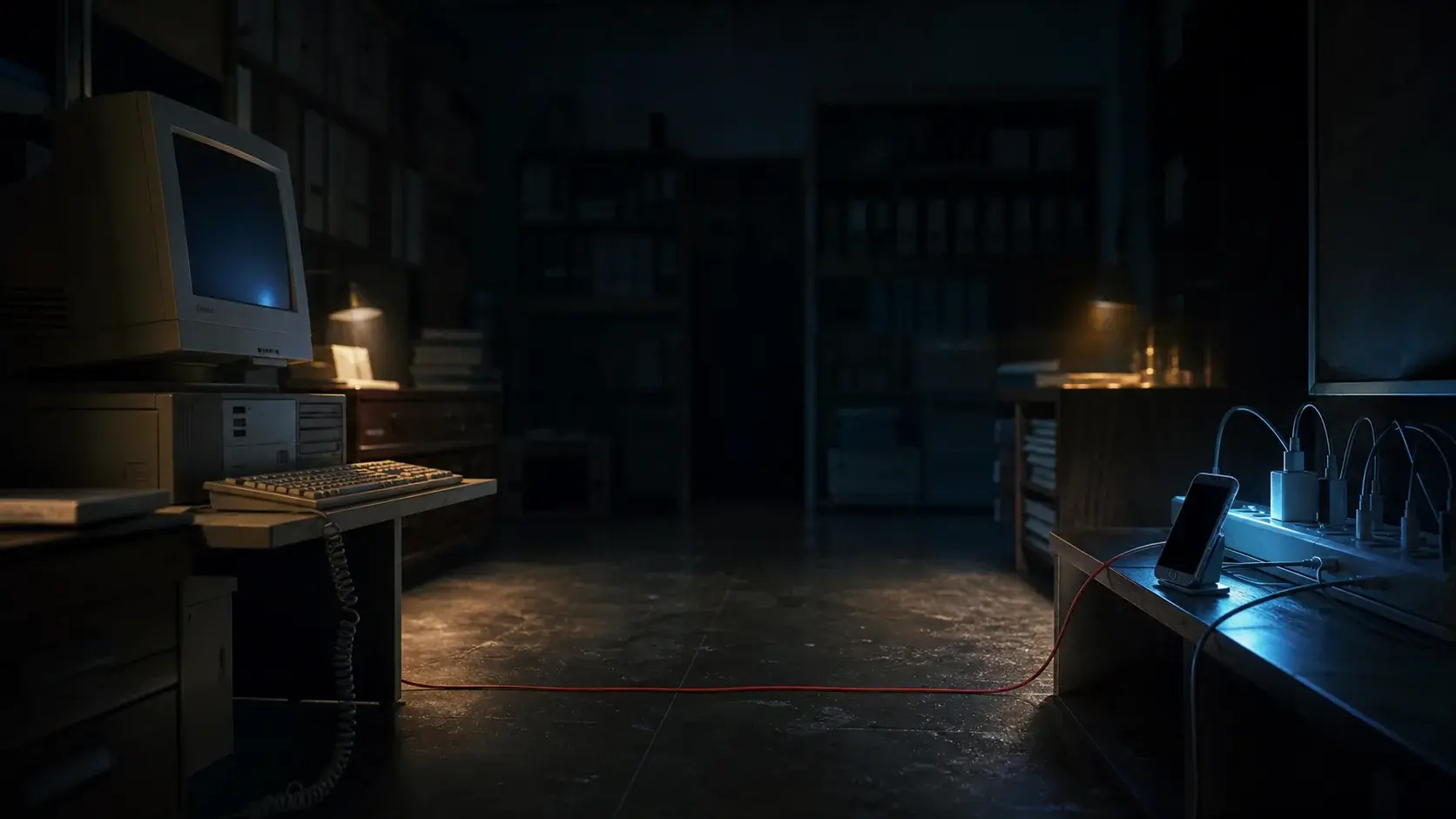
ROOM.LOG / 011999—now
An empty archive room linking a 1990s CRT computer to a contemporary smartphone with one red cable.
21K → 20.5MTrust becomes inherited warning
Evidence plate // 01
  • trust
  • aftermath
  • fluency

Chapter 01 1999—now

The generation that had to find out the hard way

One generation trusted the room. The next inherited the warning.

Every safety framework parents had inherited by the 1990s was built for a different threat entirely. Stranger danger, as taught in a thousand elementary school assemblies, described a man in a van outside a schoolyard: a discrete, visible, physically located threat that a child could be trained to recognize and flee. The internet did not produce that threat. It produced something structurally new, an adult occupying the exact same undifferentiated space as a child's actual friends, indistinguishable at first contact, who did not need to lure anyone into a van because the van had been rendered unnecessary. Grooming online is not a single frightening encounter. It is a slow accretion of ordinary-seeming attention, spread across weeks or months, that erodes a child's instinct to be alarmed precisely because nothing about any single message feels alarming. The 1980s safety curriculum simply had no shape that fit this. Parents were not negligent so much as several technological generations behind a threat their own vocabulary couldn't describe.

Compounding this, the culture that produced the early consumer internet was itself allergic to the idea that any of this needed policing. The founding disposition of that era, inherited from an earlier wave of hacker and civil-libertarian thinking, treated anonymity and unverified interaction as the internet's core virtue rather than its central vulnerability: a space where nobody could be discriminated against for their age, race, gender, or appearance, precisely because nobody could confirm any of it. That framing was not wrong about its own ideals. It was simply unprepared for what happens when the same unverifiable openness that let a bullied fourteen-year-old find a community of fellow enthusiasts also let an adult with sexual interest in children walk into the identical room wearing the identical anonymity.

Millennials, as both the first cohort of children raised with home internet access and the entrepreneurs who built the platforms that followed, were the field trial for all of this, in both directions. They were the users who assumed, reasonably, that a website's stated age requirement meant something. They were also the founders who assumed, catastrophically, that giving people a webcam and a chat box would not immediately be used by some meaningful fraction of the audience to extract, coerce, and trade images of children, and that the handful of monitors they'd hired could catch it. Nobody who built AOL's chat infrastructure, MSN's rooms, or Stickam's broadcast tools was running the numbers on what mass, cheap, real-time video would do once it met an adult population that had never before had frictionless, anonymous access to a child's bedroom. Nobody had run those numbers because nobody could have; the technology to ask the question hadn't existed a decade earlier. There was no actuarial table for this. There was only the platform, the traffic graph climbing, and the slow, expensive discovery of what the traffic was actually made of.

The scale of that discovery, once someone finally started measuring it, is its own argument for how badly this was missed. The National Center for Missing and Exploited Children's CyberTipline, the closest thing the country has to a real-time gauge of the problem, received roughly 21,000 reports of suspected child sexual exploitation in the year 2000. By 2024 that figure had reached 20.5 million, and reports specifically involving online enticement, the grooming-and-sextortion category, climbed from around 44,000 in 2021 to more than 546,000 in 2024 to 1.4 million in 2025. No engineer in 1999 planning a chat room feature was pricing in a threat that would grow three orders of magnitude within a single working lifetime. Millennials built the room assuming good faith would roughly balance bad, because that had been a defensible assumption about most prior forms of media. It stopped being a defensible assumption very quickly, and the generation that came after inherited the correction, not as a lesson taught but as a set of instincts absorbed by osmosis, from headlines, from group chats, from watching it happen to someone in their own class.
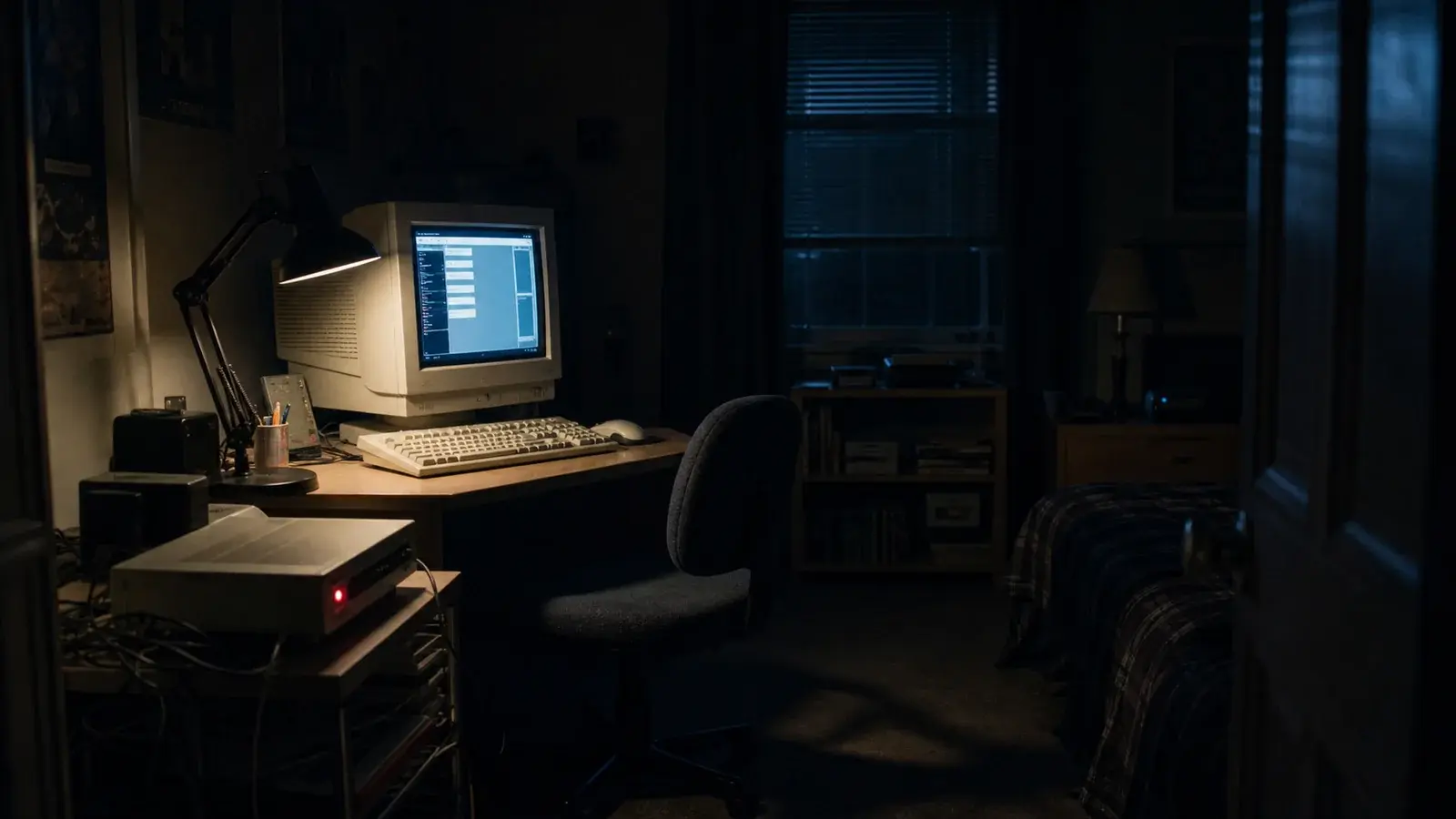
ROOM.LOG / 021994—2005
An empty 1990s bedroom with a glowing CRT computer, modem, cables, and desk lamp.
28 countriesPublic room / private exit
Evidence plate // 02
  • youth space
  • private message
  • liability

Chapter 02 1994—2005

The room gets built (1994 to 2005)

The room was never neutral. It was a distribution system.

The pattern predates video and predates broadband. It begins the moment strangers could type at one another in real time.

America Online's chat rooms in the mid-1990s were the first mass-market venue where adults and children occupied shared, unmoderated space, and the consequences arrived almost immediately. In 1995 the FBI opened Operation Innocent Images, its first major national initiative against online child exploitation, after investigators found offenders using AOL rooms and private messages to groom children and trade abusive material. The behavioral pattern agents documented then is, beat for beat, the one platforms are still fighting three decades later: an adult enters a youth-heavy space, offers the kind of attention that flatters and specifies, migrates the conversation somewhere private, escalates gradually, and then uses secrecy and shame to keep the child from telling anyone.

The corporate response established the cycle's second, and more cynical, law: platforms act once liability outpaces engagement, and not a moment sooner. In September 2003, Microsoft shuttered unmoderated MSN chat rooms across 28 countries, citing the risk of predators approaching children directly, one of the first instances of a major technology company amputating a genuinely popular feature purely on safety grounds. Yahoo followed in 2005, eliminating user-created rooms after reporters found rooms whose titles openly advertised sexual interest in minors, and after major advertisers began pulling their spending. The rooms had not suddenly become more dangerous. They had suddenly become expensive.

Television gave the public a comforting villain to focus on instead of the architecture. NBC's To Catch a Predator turned chatroom grooming into appointment viewing and fixed, in the culture's imagination, the idea of the internet predator as a single identifiable man who could be lured into a sting house and shamed on camera. MySpace, under pressure from a coalition of state attorneys general, purged tens of thousands of registered sex offenders from its user base. The public lesson absorbed from all of this was that the danger was a finite, catchable list of bad actors. The lesson the underlying data was quietly teaching, that the danger was structural and would regenerate under any system pairing visible minors with anonymous adults, went unlearned for a full generation.

ROOM.LOG / 032004—2013
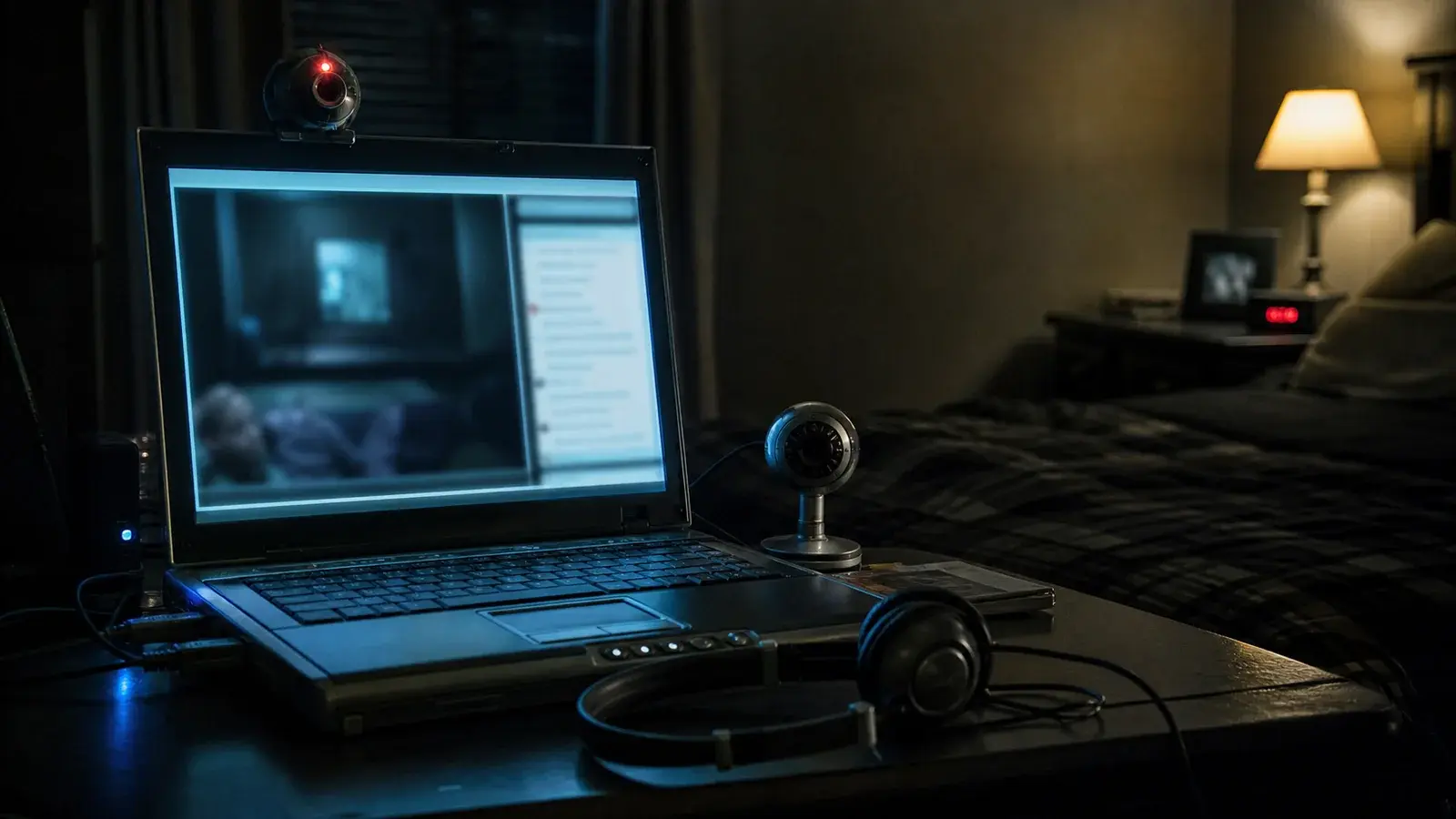
An empty late-2000s bedroom with a laptop, two webcams, and a red camera light.
600K reportsThe audience talks back
Evidence plate // 03
  • bedroom feed
  • chat prompt
  • capture market

Chapter 03 2004—2013

The webcam turns on, and a parallel industry turns on beside it (2004 to 2013)

The webcam turned attention into a request loop.

Two platforms launched within six months of each other in 2004 and 2005, aimed at what looked like entirely separate audiences, and between them they define the era.

MyFreeCams went live on August 28, 2004, an explicitly adult webcam site built around a token economy: viewers buy credits, models earn a cut of every credit tipped their way, and the platform takes the rest. It is, by design, unambiguous about what it is. By 2010 the trade press was describing it as one of the largest adult webcam communities in the world, with more than 100,000 models and five million members; industry surveys since have put roughly 40 percent of the global camming workforce in Eastern Europe, concentrated in Romania and Ukraine, a labor geography that will matter enormously later in this story. The site's founder, Leonid Radvinsky, would go on in 2018 to purchase a 75 percent stake in a small British subscription platform called OnlyFans, carrying an entire generation's worth of camming-industry infrastructure, payment rails, and monetization logic directly into what would become the defining platform of the next decade. The line from the first cam economy to the modern creator economy is not a metaphor. It runs through one man's cap table.

Stickam launched in February 2005, five months after MyFreeCams, and was built for the opposite stated audience: teenagers, broadcasting live from their bedrooms, with a chat box beside the video for real-time interaction. By 2012 it claimed over nine million registered users. It invented, more or less by accident, the entire grammar that every subsequent platform in this story would reuse: the parasocial bedroom broadcast, the viewer-request dynamic in which the chat window tells the performer what to do next, the follower gate, even a random-pairing shuffle feature that beat Chatroulette to its own idea. And within two years it had demonstrated exactly what that grammar attracts once young broadcasters and anonymous adult viewers share a room with no meaningful verification between them. Child-safety advocates were flagging the platform by 2007. In 2009 alone, American authorities made multiple arrests connected to the site, including a man who posed as a teenage boy to manipulate underage girls into sexual acts on camera, amassing more than a hundred videos, and another who coerced a fourteen-year-old before arranging to meet her in person. Reporters also traced financial links between Stickam's parent company and adult webcam businesses, an early and largely unremarked-upon instance of the exact boundary this essay keeps returning to: the wall between the "teen platform" and the "adult platform" has never been as load-bearing as either side liked to claim.

Stickam's era also produced the mechanism that makes this kind of exploitation permanent rather than momentary. Because live video vanishes the instant the broadcast ends, a subculture formed almost immediately around capturing it. Viewers recorded broadcasts, especially the moments when young streamers were dared, coaxed, or manipulated into removing clothing, and archived the footage for later trade. Investigators now use the clinical phrase "self-generated" material for this: content a child technically produced with her own hands, under manipulation she may not have fully understood in the moment, which then persists indefinitely, entirely beyond the reach of whatever platform hosted the original broadcast. The UK's Internet Watch Foundation has reported that self-generated imagery, much of it depicting girls between eleven and thirteen in their own bedrooms, now constitutes the majority of the abusive material its analysts remove from the internet. Every frame of that majority is the long shadow of a chat window that said do it, and a child who wanted the room to like her.

Stickam died in January 2013 with a single day's notice, officially a casualty of obsolete Flash technology. Its audience, on both sides of the camera, simply relocated.

Where a great deal of it relocated to was Omegle, launched in 2009 by an eighteen-year-old and stripped down to the mechanic's rawest possible form: press a button, face a stranger on video, no account required, no name attached, no age verification of any kind. For years its splash screen carried a genuinely remarkable sentence, warning users that predators were known to use the platform, a line that functioned less like protection than like a liability waiver, and which the site eventually deleted rather than acted upon. A CBC reporter using the platform in 2022 found that most strangers she was randomly paired with appeared to be adult men, either naked or deliberately positioned off-camera. That same year, a site run by a skeleton crew filed more than 600,000 reports of apparent child sexual exploitation to the CyberTipline, more than TikTok, Snapchat, or Discord combined.

The lawsuit that ended Omegle reads like a schematic diagram of the entire cycle described in this essay. In 2014, an eleven-year-old girl, identified in court filings as A.M., was randomly matched on Omegle with a Canadian man in his late thirties. According to her complaint, he obtained her contact information and spent the following three years exploiting her, coercing her into producing abusive material for himself and his associates, and eventually directing her to return to Omegle specifically to recruit other girls for him. The victim became, under duress, the platform's own recruiting arm. When she sued, Omegle raised the defense every platform in this story reaches for, Section 230 of the Communications Decency Act, which shields sites from liability for what third parties post. The presiding judge rejected it. The harm, he found, flowed from the deliberate design of the product itself, the choice to randomly pair unverified children with unverified adults, and design decisions are not speech. Omegle settled in November 2023 and shut down within days. Its founder's farewell letter conceded the platform had been used to commit, in his own words, unspeakably heinous crimes, and, as a term of the settlement, thanked the victim by name.

Even in death, Omegle demonstrated the cycle's central and most durable law. Monitors watching dark-web forums recorded users mourning the shutdown and openly discussing where to relocate. A lawyer for a separate child victim told Forbes the harm would simply continue elsewhere, because shutting a site does not change the underlying behavior. The demand migrates. It has never once failed to migrate.

ROOM.LOG / 042013—2021
A livestream phone rig surrounded by physical gift tokens, coins, lights, and cables.
age → priceAge becomes a market signal
Evidence plate // 04
  • coins
  • search terms
  • payment pressure

Chapter 04 2013—2021

The money arrives, and age becomes a search term (2013 to 2021)

Once youth acquired a price, the search box became part of the market.

The smartphone rewired the economics. Where Stickam's teenagers had performed for attention, the mobile-era generation performed for attention that converted directly into currency, and that conversion is the hinge the rest of this history turns on.

YouNow inherited Stickam's teen broadcast audience in 2011 and pioneered gifting: virtual items purchased with real money, sent to broadcasters in real time, partially cashable. Live.me, launched in 2016 and promoted heavily through Musical.ly, ran an identical economy and drew scrutiny after investigations found adults using gifts to solicit sexual displays from streamers who were visibly underage. Kik Messenger became the connective tissue of the entire era, an anonymous messenger so thoroughly saturated with grooming activity that law enforcement agencies on three continents described it as a near-constant fixture of their child-exploitation caseloads. Periscope, Twitter's marquee 2015 acquisition, showed what happens when a corporation with real resources inherits the pattern and still fails to contain it: by late 2017, a Gizmodo investigation found dozens of accounts openly soliciting sexualized imagery of minors, several using explicit images of children as their own profile pictures, many with thousands of followers despite zero public broadcasts, because the actual activity had migrated into Periscope's private groups feature. Twitter announced it had banned 36,000 accounts that year for inappropriate engagement with minors, a figure offered as reassurance that read, on closer inspection, as an admission of scale. Periscope shut down in 2021, officially for reasons of cost.

Meanwhile Musical.ly, the lip-sync app that millions of pre-teens used to perform to pop songs and that would eventually be folded into TikTok, ran headlong into the same discovery MyFreeCams and Stickam had already made a decade earlier, minus the excuse of novelty. The Federal Trade Commission found that the app was, by its own internal knowledge, used by a large population of children under thirteen, that it collected their names, contact information, and geolocation without parental consent, and that some of that data included photos and videos containing a child's image and voice, alongside private messages between users the company had made no meaningful effort to monitor. Until July 2017, the app did not even ask for a user's age at signup. In February 2019, the FTC fined the company, by then rebranded TikTok, $5.7 million, at the time the largest civil penalty the agency had ever obtained in a children's privacy case. It was not, on ByteDance's balance sheet, a deterrent. It was a rounding error against a company valued at 75 billion dollars, and it changed the platform's age-gating architecture without meaningfully slowing its growth: from 133 million users in 2018 to roughly 1.5 billion worldwide within six years.

It was against this backdrop, and largely because of it, that the adult content industry converged on a strange and telling piece of market intelligence: youth itself, real or performed, functions as a search category with commercial value distinct from any performer's actual identity. This is the least comfortable thread in this whole history and the one most worth naming precisely, because it clarifies everything downstream. In December 2020, New York Times columnist Nicholas Kristof published "The Children of Pornhub," an investigation built on interviews with survivors whose assaults had been filmed and uploaded without consent, alongside documentation of the site's persistent failure to act on searches and titles that pointed directly toward content involving minors. Within days, Visa and Mastercard suspended their payment services to the platform pending independent investigations; both later confirmed the presence of illegal content and permanently or indefinitely cut ties. Pornhub responded by deleting roughly ten million videos overnight, about 80 percent of everything on the site, and restricting uploads to verified accounts only. That a single newspaper column could force a platform to erase four-fifths of its own library within a week says something precise about how thin the compliance infrastructure had actually been the entire time: not fragile in the sense of being new, but fragile in the sense of never having been genuinely built. The "teen" search category itself, separate from any individual performer's true age, had for years functioned as one of the most reliably profitable classifications on the internet's largest pornography platforms, a fact that predates Pornhub, predates the internet, and connects directly to a much older marketing genre sometimes called "barely legal," built entirely around the commercial premise that the appearance of youth, freshly and just legally available, is itself the product. An industry that treats age as a marketable aesthetic will always generate pressure toward its edge. That pressure does not stay contained to the adult industry's own platforms. It leaks, predictably, into every youth-heavy space next door.

And here is where the two halves of this section meet. Because at almost the exact same moment the FTC was fining Musical.ly for failing to keep young children off a lip-sync app, the search economy on adult platforms was rewarding exactly the outcome that failure produced. A platform saturated with children, indifferent to enforcing its own age floor, sitting one link away from an industry that had already learned age is a keyword worth paying for: that is not two separate problems occurring in parallel. That is a supply chain.

By 2021 the lifecycle running through all of this could be written as a formula, because every platform in this section ran the same course. Stage one: a niche product launches with a novel social mechanic and functionally no safety infrastructure. Stage two: young people colonize it, because young people colonize everything new and because it offers the one thing adolescence is starved for, which is an audience. Stage three: adults with disposable money arrive, drawn precisely by the youth of the room, and begin shaping behavior through attention, dares, and cash. Stage four: the platform formalizes the money into gifts, tokens, or coins, takes its percentage of every transaction, and becomes financially dependent on the exact dynamic that is destroying its users. Stage five: performers escalate, because escalation is what the ranked feed pays for; a journalist or a litigator eventually forces a reckoning; the platform dies or mutates; the audience, on both sides of the camera, disperses to stage one of whatever comes next.

Stickam, Omegle, Live.me, and Periscope all ran the complete course. MyFreeCams, notably, did not, because it never lied about what it was in the first place. The platforms that eventually escaped the lifecycle were not the ones that eliminated the underlying economy. They were the ones large enough to absorb its liabilities as a cost of doing business.

ROOM.LOG / 05Permanent
A forensic archive table showing recording media evolving from VHS tapes to cloud storage along one red cable.
the archive persistsCapture outlives the room
Evidence plate // 05
  • capture
  • copies
  • leverage

Chapter 05 Permanent

The archive that never closes

The platform can close. The captured material does not close with it.

None of this activity has ever stayed confined to the platform that originated it, because the platforms themselves are ephemeral and the appetite they generate is not. A parallel, quieter infrastructure has existed for as long as this whole story has, built specifically to capture, catalogue, and preserve exactly the material the platforms eventually deleted.

The clearest documented case study sits, of all places, on Reddit, a mainstream site that spent years hosting one of the internet's most notorious communities of this kind entirely in the open. A forum built around sexualized images of minors existed on the platform for years after subreddit creation opened to the public in 2008, accumulating tens of thousands of subscribers before CNN's Anderson Cooper aired a report on it in October 2011. The report, perversely, drove the forum's traffic up rather than down; by one contemporaneous count it gained more than 130,000 new visitors and a thousand new subscribers in the days that followed, a fact that itself says something uncomfortable about how large and how casual its existing audience already was. Reddit's leadership initially defended the community on free-speech grounds. It took a Gawker exposé identifying the forum's chief moderator by name in October 2012, and the resulting employer and public backlash, before Reddit finally banned all subreddits organized around the sexualization of minors, a policy the company only formalized site-wide that year, followed by a broader quarantine system introduced in 2015 to make similar communities harder to stumble into by accident.

What that thirteen-year story demonstrates is the general shape every subsequent version of this problem has followed. A community forms, openly or semi-openly, on infrastructure that was never designed to host it. It survives for years on the platform's reluctance to lose the engagement, the traffic, or the free-speech argument. It is eventually exposed by an outside party, journalist or researcher rather than the platform's own trust-and-safety apparatus, and only then acted upon, usually under public or advertiser pressure rather than a change of institutional conviction. And it does not disappear when it is banned. It fragments, migrates to encrypted messaging apps and smaller forums with less scrutiny, and continues operating with a smaller but more resilient footprint, harder for outside researchers to see and therefore harder to shame into shutting down again. Researchers at Stanford's Internet Observatory documented a version of the same pattern on X in 2023, finding networks distributing self-generated child sexual abuse material operating on the platform in the aftermath of major cuts to its trust-and-safety staff, a finding that connects directly to the "link in bio" economy described later in this piece: X functions, for this entire industry, as the free, high-traffic marketing layer that funnels an audience toward paid content hosted somewhere else entirely.

The correct way to describe this archive economy in print is the way this essay is describing it: acknowledging that it exists, that it has a documented and repeatable structure, and that it has proven durable across three decades and at least four major platform collapses, without providing anything resembling a map to where it currently lives. That omission is not squeamishness. It is the only responsible way to write about something whose entire function depends on being findable by exactly the wrong readers.

ROOM.LOG / 062022—now
An empty creator studio connected by cables to a corporate analytics control room.
112K minorsCommissioned engagement
Evidence plate // 06
  • algorithm
  • gift rail
  • age gate

Chapter 06 2022—now

The strip club goes corporate

The behavior that killed platforms became a line of business.

In April 2022, Forbes reporter Alexandra S. Levine published an investigation into TikTok Live that should, by the standards of every prior platform in this history, have been an extinction-level event. She documented, across hundreds of streams, adult viewers using the comment section to direct teenage girls broadcasting from bedrooms and bathrooms through steadily escalating requests, rewarding compliance with virtual gifts convertible to cash or with direct payments routed to Cash App and Venmo handles the girls had listed in their bios. Viewers had developed an entire coded vocabulary of innocuous-sounding prompts engineered to produce compliance without tripping moderation filters, requests that read as games and function as instructions. A Harvard Law School dean quoted in the piece compared the feature to a strip club staffed by fifteen-year-olds. A Homeland Security agent explained the predator-side economics with unsentimental clarity: a ten-dollar gift is a remarkable investment, because it gets a child doing something she would not otherwise have done, and once she has done it, the leverage exists to demand more. That is the sextortion pipeline in miniature, and livestream gifting is one of its widest, best-lit entrances.

What elevates this from scandal to indictment is what the company did after the story broke, something the public only learned because more than a dozen state attorneys general later sued and the resulting court filings were imperfectly redacted. Internally, TikTok launched an investigation code-named Project Meramec. It confirmed, in the company's own words, essentially everything Forbes had alleged. In a single month of 2022, roughly 112,000 underage users hosted livestreams in direct violation of the platform's own stated age policy. Viewers sent approximately one million gifts to minors engaged in what internal documents blandly termed transactional behavior. The recommendation algorithm was found to be actively amplifying the sexualized streams, because they reliably drove the highest engagement, and TikTok collected its standard commission on every gift sent. A second internal probe, Project Jupiter, found the identical gifting infrastructure being used to launder proceeds from drug sales. One internal message, later quoted in litigation, compresses this entire essay into a single sentence: the content generating the platform's highest engagement was not the content the company said it wanted.

More than a dozen states sued across 2024 and 2025. Utah's complaint called TikTok Live a virtual strip club in language nearly identical to the Harvard dean's two years earlier. Minnesota's alleged the company was, in effect, operating an unlicensed money-transmission system profiting directly from the sexual and financial exploitation of children. TikTok disputes the characterizations and points to its safety policies. But notice precisely what did not happen in response to any of it. TikTok Live was not shut down. Nobody's farewell letter thanked a named victim. The feature an internal company investigation had already confirmed was monetizing minors is, as of this writing, still running at global scale, because TikTok is not a scrappy site that can be sued into oblivion the way Omegle was. It is one of the largest media products in human history, and the gifting economy is, by the company's own internal accounting, load-bearing.

This is worth grounding in the platform's own demographic arc, because the numbers tell a quietly damning story about who actually funds the room. Teens between thirteen and nineteen made up roughly 32 percent of TikTok's user base when it crossed one billion monthly active users in September 2021. By 2026, that share had fallen to around 25 percent, even as the platform's total audience nearly doubled, because the fastest-growing cohorts have been users in their thirties, forties, and fifties, whose share of the platform rose from about 22 percent to 38 percent over the same period. TikTok's own marketing now leans into this, framing itself explicitly as no longer just a Gen Z platform, because older users carry more disposable income and are more valuable to advertisers. That reframing is not incidental to this essay's argument. It is the argument, restated as a business strategy: the platform's cultural engine, the thing that makes it feel alive and drives its virality, is still disproportionately teenage. Its revenue engine, the population actually capable of subscribing, buying, and gifting at scale, is disproportionately adult and getting more so every year. A platform can be built by teenagers and sustained by their parents' generation simultaneously, and TikTok is, at the moment, the largest working proof of that arrangement on Earth.

There is a further structural mechanism worth naming here, because it explains why the behavior on these platforms escalates rather than plateaus. A ranked, algorithmically sorted feed is a zero-sum tournament: only a finite number of slots exist on any given "For You" page, and every creator competing for youth-audience attention is competing not against some abstract standard but against every other creator's most extreme recent post. In evolutionary biology this kind of arrangement, where standing still means falling behind because everyone else keeps moving, is sometimes called a Red Queen dynamic. Livestreaming built the purest possible version of it for children: an environment where the reward for yesterday's dare is not satisfaction but the certainty that today's dare has to be larger, because a thousand other thirteen-year-olds are dancing for the exact same finite pool of gifts. Nobody needs to design this outcome. The ranking algorithm produces it automatically, as a mathematical consequence of optimizing for engagement among a fixed audience with a limited attention budget. The children are not competing against predators in any of this. They are competing against each other, for an audience that predators happen to be disproportionately represented within.

ROOM.LOG / 07Brazil
Phones and network cables crossing a worn world map on a dark operations table.
64% of reportsCulture plus inequality
Evidence plate // 07
  • search term
  • comment ritual
  • ad library

Chapter 07 Brazil

Novinha, and the girls the algorithm exports

The market crosses borders faster than safeguards.

Everything described so far intensifies once it crosses into economies where the demand side is wealthy relative to the supply side, and where the cultural machinery for sexualizing girls predates the internet by generations and is already set to music.

Brazil is the starkest documented case, and its vocabulary tells the story before its statistics do. Novinha is an ordinary Portuguese diminutive, meaning simply "young girl." It is also one of the most frequently used words in Brazilian funk, a genre whose lyrics have for two decades attached the word to desire, and which now soundtracks the dance videos Brazilian children post by the million. The word functions simultaneously as a genre label, a search term, and a market signal. When a girl in João Pessoa or Belém posts a dancinha, a small TikTok dance filmed in her school uniform, the word already waiting in the caption space is one the surrounding culture sexualized for her well before she had any say in the frame.

In August 2025, Brazilian comedian Felipe Bressanim Pereira, known online as Felca, made this legible to a national audience with a single, simple experiment. He built a fresh Instagram account, searched terms he suspected predatory accounts were using, liked a handful of videos that felt engineered rather than innocent, and then simply scrolled. What the algorithm served him back was a feed of ordinary children, jumping into pools, dancing in bedrooms, doing nothing remarkable at all, sitting beneath comment sections saturated with a repeated coded vocabulary, much of it posted as GIFs specifically to dodge text filters, requesting further content or a trade elsewhere. Felca called the pattern the "Algoritmo P," and his video, titled "adultização," reached more than forty million views. Within nine days, the most prominent influencer named in it, a man who had built an audience of eighteen million filming a rotating cast of minors in a sexualized reality-show format, was under arrest.

That man, Hytalo Santos, had been under investigation by prosecutors in Paraíba since 2024, after neighbors reported parties involving alcohol and children, but it took Felca's video to make the case nationally impossible to ignore. Santos was later convicted and, alongside his partner, also faces labor-court proceedings for human trafficking and conditions the court described as analogous to slavery. One of the girls in his content had been part of his productions since she was twelve. His defense argued that everything had been filmed with parental authorization and that the older girls involved were legally emancipated, a detail worth sitting with, because in the adultização economy the parents are frequently inside the production rather than protecting against it. Felca's original video documented a separate case entirely: a mother selling explicit material of her own teenage daughter through Telegram after followers repeatedly asked for more.

The reporting statistics around the scandal describe an accelerating rather than a stable crisis. SaferNet Brasil logged nearly 77,000 reports of online rights violations in the first seven months of 2025 alone, 64 percent of them tied specifically to child sexual abuse and exploitation. Reports of child sexual abuse material more than doubled in the immediate aftermath of Felca's video, which is what typically happens when an entire country is suddenly handed the vocabulary to recognize what it had been scrolling past. Congress, visibly shamed into action, passed the ECA Digital, a comprehensive child-protection statute that had been stalled since 2022, within three weeks. Article 23 of the resulting law explicitly bans platforms from monetizing or algorithmically boosting any content portraying children in an eroticized or sexually suggestive manner, one of the more forceful provisions of its kind anywhere in the world on paper.

What happened next is the part regulation cannot yet answer for. In the first week after the law took effect in March 2026, Brazilian journalists checking Meta's own public advertising library found boosted, paid, company-approved advertisements openly promising leaked content of novinhas, students, and, in the platform's own uncensored phrasing, incest. Predatory accounts continued trawling years-old footage of young girls, leaving comments in Portuguese, Spanish, and English, since a dance video posted three years earlier remains, functionally, a live point of contact today. Brazil built one of the strongest child-protection statutes on the books anywhere, and within seven days the market it was built to interrupt had already found the seam in it.

Brazil is the loudest documented example of this pattern, not the only one. The same underlying dynamic, wealthy demand meeting cheap supply, runs through the gifting economies of Southeast Asia, where investigations have repeatedly found broadcasters in poorer nations performing for viewers in wealthier ones. At the extreme end of that same spectrum sits the fully commercialized, on-demand livestreamed abuse economy that law enforcement has spent more than a decade dismantling in the Philippines, where joint international operations uncovered networks selling live abuse of children to customers abroad, with individual acts priced, obscenely, at less than the cost of a modest dinner. The distance between a gift-baited request on a public stream and a purchased private show is a gradient, not a wall, and the machinery of global economic inequality reliably pushes girls down that gradient rather than up it.

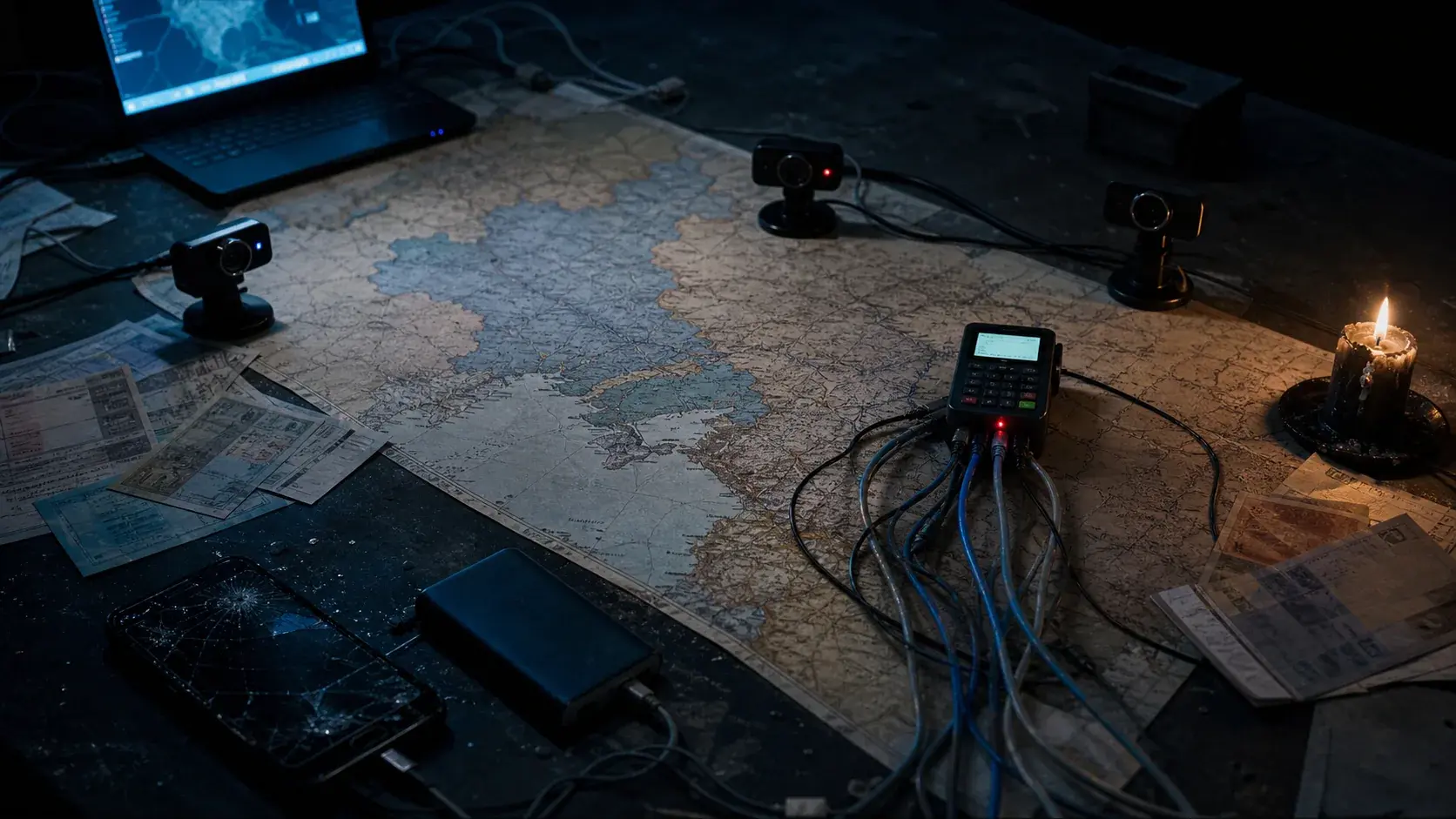
ROOM.LOG / 082014—now
A worn regional map, webcams, cracked phone, blackout candle, and payment terminal connected by cables.
labor geographyPayment crosses borders
Evidence plate // 08
  • war
  • currency
  • platform labor

Chapter 08 2014—now

The geography of desperation: Ukraine, Russia, and Turkey

The market follows economic precarity faster than safeguards can follow it.

If Brazil demonstrates how a youth-obsessed algorithm manufactures supply, three other countries demonstrate the second, equally reliable accelerant: catastrophic economic desperation, which does not create this industry so much as pour an entire adult labor force into infrastructure the camming era had already built.

The historical labor geography of webcam work has, for two decades, run disproportionately through Eastern Europe. Industry surveys place roughly 40 percent of the global camming workforce in the region, concentrated in Romania and Ukraine, a pattern that predates any of the specific platforms discussed above and reflects a simpler underlying fact: for a woman earning in euros or dollars from a country where local wages have collapsed relative to Western currencies, camming has functioned since the mid-2000s as one of the few remotely accessible forms of hard-currency income available without formal credentials, a visa, or an employer.

Russia's full-scale invasion of Ukraine in February 2022 detonated that entire equation on both sides of the border simultaneously. Inside Ukraine, the war produced what the United Nations has described as the country's greatest economic crisis since independence: roughly seven million internally displaced people by early 2023, a third of all previously employed Ukrainians, some 6.4 million people, out of work in the war's opening months, and by 2024 only 48 percent of displaced women employed compared with 71 percent of displaced men, with women's average earnings falling more than 41 percent below men's, a gap that had doubled since 2021. Journalists covering the period documented Ukrainian women turning to OnlyFans in what several described, in their own words, as a last resort rather than a career choice, a direct and traceable line from artillery-driven unemployment to a subscription page. Inside Russia, the mirror image played out through sanctions rather than displacement: OnlyFans blocked Russian creators from the platform entirely, pushing a wave of Russian women toward Chaturbate and comparable sites instead. One cam model interviewed by Deutsche Welle in 2023 described earning roughly 2,100 euros a month on Chaturbate, more than double the average quarterly wage reported inside Russia at the time, even as increased competition from the influx of newly displaced Russian workers and open hostility from international customers over her nationality both cut into what she could earn. War, in this specific industry, functions less like an external shock than like a pressure gradient, pushing labor supply in whichever direction the sanctions regime and the currency markets happen to bend it.

Turkey offers a third, distinct variation on the same underlying mechanism: not war, but sustained currency collapse. A 2025 academic study of Turkish OnlyFans creators found that most of the women interviewed explicitly declined to describe themselves as sex workers at all, preferring the word "influencer," and cited the country's ongoing economic decay, specifically the ability to earn and be paid in dollars while spending in a rapidly devaluing lira, as their primary motivation for joining the platform. That pattern did not begin with OnlyFans. An earlier industry estimate placed the number of women working in Turkey's online sex-chat economy at roughly 20,000, some earning the equivalent of a modest monthly wage through webcam and text-based services years before the subscription-platform era began, evidence that the underlying economic mechanism long predates any single company's product decisions. Similar dynamics have been documented by Human Rights Watch in Colombia, where webcam studios have been found imposing commission structures as high as 50 percent alongside documented cases of coercion, layered directly on top of the same currency-arbitrage logic driving the Turkish and Ukrainian cases: platforms priced in dollars or euros, paying out into economies where that currency goes further, creating an economic pull that no amount of platform-level age verification or content policy was ever designed to counteract, because the pull operates one full level below the platform, in the underlying currency markets themselves.

None of this is a story about any single country's culture or values. It is a story about arbitrage: a global platform economy that prices its labor in strong currencies and recruits, disproportionately and predictably, from wherever the local currency is weakest, the local economy least stable, and the available alternatives fewest.

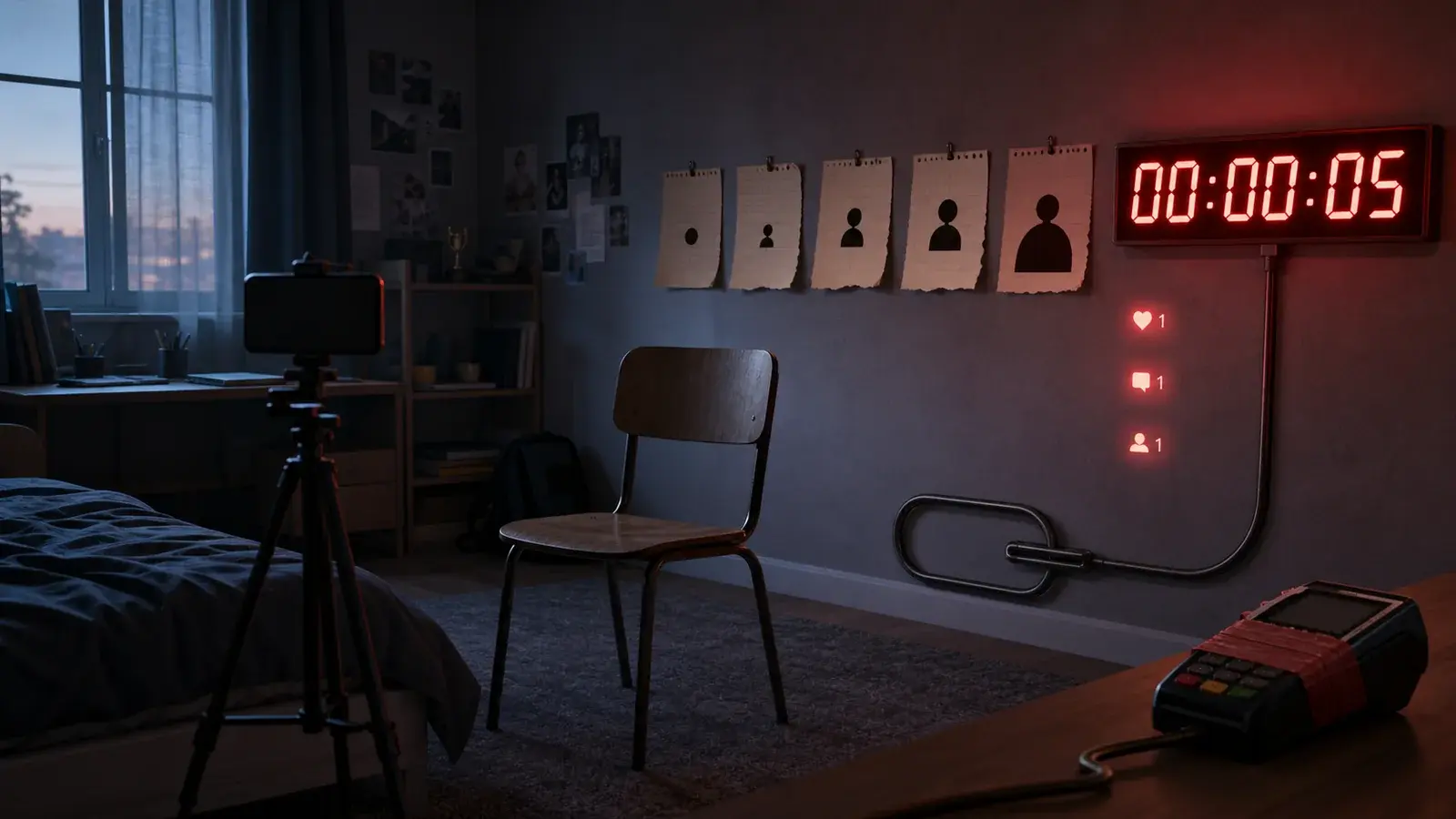
ROOM.LOG / 0913 → 18
An empty chair facing a phone camera, calendar sheets, countdown display, and payment terminal.
adulthood pre-soldAudience as pipeline
Evidence plate // 09
  • followers
  • capture
  • subscription

Chapter 09 13 → 18

One girl, followed all the way through

The link in bio connects the audience built around a child to the market waiting for an adult.

Now follow a single trajectory all the way to its endpoint, because the pipeline this essay has been describing only makes complete sense as a biography rather than a diagram.

She is thirteen when she posts her first dance video. The algorithm, which by now has been extensively documented to do exactly this, gives it more reach than anything she has made before, because the audience for thirteen-year-olds dancing is large, engaged, and disproportionately willing to comment. The comments teach her the unstated rules faster than any parent could: this angle, that particular movement, this style of top rather than that one. At fourteen she goes live for the first time, and the gifts begin, small ones at first, attached to small requests that read as playful. She learns, the way every broadcaster back to the Stickam era has learned, that compliance is retention and hesitation is churn. By fifteen, some of her clips have already been captured and reposted to accounts and forums she will never see, where commenters openly annotate her age. By sixteen, part of her following has begun counting down, publicly, in the comments, toward a date on which her body becomes legally sellable to the very audience that has been rehearsing that transaction with her for three years already. Her adulthood, when it finally arrives, is pre-sold.

So on or near her eighteenth birthday, she opens a subscription page, and the adults who spent five years training her for this moment perform surprise.

The infrastructure waiting to receive her is not marginal. It is mainstream, global, and enormous: OnlyFans alone processed 6.6 billion dollars in payments in 2023, with more than four million registered creators and 370 million registered users worldwide. Its promotional layer runs almost entirely through X, the one major Western platform that has formally, in written policy, permitted pornographic content, making the entire funnel frictionless and, crucially, familiar, since she has effectively been rehearsing its mechanics for half a decade already: post free teaser content on X or TikTok, place a single link in the bio, let that link carry the audience she built as a minor directly to the platform where that same audience now pays. A 2020 BBC investigation, using research the network had specifically commissioned, found that on a single sampled day, roughly a third of the Twitter profiles worldwide advertising sexual content for sale appeared to belong to underage individuals, a meaningful share of them funneling traffic directly to OnlyFans. The BBC's follow-up reporting in 2021 found OnlyFans was failing to keep those underage creators off the platform in any systematic way; Reuters found predators still actively exploiting children there in 2024. The front door has an identification check. The building, as it has for thirty years running, has other doors that were never sealed.

Here is the uncomfortable part of the biography, the part that explains why so many people inside this pipeline describe it, afterward, as something that happened to them rather than something they chose. By eighteen, she carries years of behavioral conditioning that adult male attention converts directly to income. She carries an audience that was assembled around her body before she had any legal capacity to consent to selling access to it, an asset she did not build on purpose but that happens to be the only asset the preceding five years actually let her build. She frequently carries images that were already captured and are already circulating somewhere she cannot reach, which collapses the usual psychological threshold entirely: the material has already been taken from her once, so monetizing it herself at least returns some fraction of the value to her rather than none. And in places like Ukraine, Turkey, or the Philippines, she often carries genuine, structural economic need, in an economy where her follower count is a more liquid and more immediately convertible credential than anything a diploma could offer her.

What she does not carry, statistically, are good odds once she arrives. The average OnlyFans creator earns roughly 1,300 dollars a year. The income distribution is savagely top-heavy, which means the platform's underlying economics run on volume at the bottom rather than glamour at the top: millions of low-earning creators, each individually incentivized to escalate, discount, and eventually do the thing she had told herself she would never do, because escalation is the only lever available to anyone stuck in the long tail. Guardian and BBC investigations published in 2026 documented an entire management-agency layer that has grown directly on top of that desperation: predominantly male-run firms taking fifty percent or more of young women's earnings, operating employed "chatters" who impersonate the creator in intimate conversation with her own paying subscribers, trading the women themselves between competing agencies like inventory, and in the most severe documented cases, shading directly into outright coercion. The empowerment platform, in its most degraded operating mode, reinvented the manager who takes half and calls it representation.

That is the complete pipeline, start to finish. A girl monetized at thirteen by a platform's ranking algorithm, harvested at fifteen by a capture-and-archive economy operating entirely outside her knowledge, counted down publicly at seventeen by her own following, onboarded at eighteen by a subscription giant processing billions in annual payments, and skimmed at nineteen by an agency that found her already exhausted and already isolated. At every single stage, someone other than her collected a percentage. The internet did not invent any individual step in that sequence. What it did, uniquely and irreversibly, was wire every step directly to the next one, remove the friction between them, and attach a progress bar the whole audience could watch in real time.

ROOM.LOG / 102020—now
An empty audio studio where a phone, radio, waveform monitor, and branching speakers share one distribution system.
distribution outruns contextThe radio edit cannot contain the feed
Evidence plate // 10
  • sound
  • challenge
  • distribution

Chapter 10 2020—now

The sound of it: distribution outruns the radio edit

The clip travels farther and faster than any warning attached to it.

This entire economy has a soundtrack, and the soundtrack changed for reasons that have less to do with any individual artist's creative evolution than with a wholesale change in how music now reaches an audience that includes children whether anyone intended it to or not.

For most of the twentieth century, sexually explicit music reached teenagers through a series of institutional filters that, however imperfectly, did real work: the radio edit, which stripped or bleeped explicit lyrics before broadcast; the Parental Advisory sticker, contested and frequently mocked but genuinely capable of triggering a store's refusal to sell an album to a minor; MTV's willingness to hold certain videos for post-primetime rotation; and the basic physical friction of a teenager needing an adult's credit card, or an adult's car, to actually acquire a physical album in the first place. None of those filters were designed with any awareness of algorithmic short-form video, and none of them survive contact with it. TikTok's recommendation engine does not check a listener's age before serving a fifteen-second clip of a song's most explicit hook set to a viral dance; it optimizes purely for completion rate and shares, and a hook built to be maximally provocative is, almost by mathematical definition, maximally likely to be shared. A song no longer needs radio play, a store shelf, or a parent's permission to reach a twelve-year-old's phone directly. It needs a fifteen-second clip and a dance.

The clearest documented case study is Cardi B and Megan Thee Stallion's 2020 single "WAP," which debuted at number one on the Billboard Hot 100 with 93 million US streams in its opening week, at the time the highest seven-day streaming total ever recorded for a song's debut, and which generated a viral TikTok dance challenge choreographed independently of the artists and performed by users across every visible age bracket on the app. The lyrical content produced a genuinely public controversy, and it is worth presenting both sides of that controversy fairly rather than adjudicating it. Critics, including Fox News commentator Tucker Carlson, argued explicitly that the song's ubiquity effectively placed sexually explicit content in front of, in his words, young American girls, regardless of the artists' intended audience. Cardi B and Megan Thee Stallion, along with a wide range of music critics, rejected that framing entirely, arguing the song was written for and about adult women reclaiming sexual agency in a genre that has always granted male rappers the identical latitude without comparable backlash, and that responsibility for what reaches a child's phone lies with the distribution mechanism and the household, not with an artist making adult art for an adult audience. Both positions can be true simultaneously without contradiction: a song can be legitimately intended for adults and still arrive, unfiltered by any institution that once stood between a teenager and adult content, directly onto that teenager's device, because the platform carrying it was never built to ask who was watching.

Doja Cat's 2020 breakout single "Say So" tells the distribution half of this story even more plainly, without needing to touch the content-controversy question at all. The song became a mainstream hit specifically because a choreographer independently built a TikTok dance around it that went viral among an overwhelmingly young user base, months before radio programmers or traditional label marketing meaningfully caught up to what the app's youngest users had already decided was a hit. That is simply how popular music now gets made and marketed: TikTok functions today as the industry's dominant discovery and promotion engine, full stop, and its core demographic, the platform's own data shows a global user base still substantially weighted toward listeners under twenty five, is also the demographic every label now needs to court first if a single is going to chart at all. This is not a story about any individual artist targeting children. It is a story about an entire industry retooling its promotional strategy around the one platform whose engagement is driven, disproportionately, by the youngest people using it.

Musical.ly's own regulatory history closes the loop on this section neatly. The same FTC complaint that fined the app $5.7 million documented, as one of its core factual findings, that a significant population of the app's users were children lip-syncing to exactly this kind of commercially explicit music, often in videos that used sexually suggestive choreography, sitting alongside a direct-messaging system that allowed unmonitored adult contact with those same children. The app that later became TikTok was, quite literally, a for-profit platform whose entire original product was children performing to adult content, built years before anyone at the company had reason to think carefully about what that combination would eventually produce downstream.

ROOM.LOG / 112010s—now
An empty hearing room with microphones, policy papers, a privacy screen, and opposing lights.
1.4M reportsA market reframed as speech
Evidence plate // 11
  • stigma
  • privacy
  • product design

Chapter 11 2010s—now

The death of shame

The consequences did not die. They were privatized.

There is one more component to this machine, and it is the one that makes the entire system culturally self-sustaining rather than merely economically profitable: the story the culture agreed to tell about it.

Somewhere in the last fifteen years, roughly between Stickam's collapse and OnlyFans' ascent, the public conversation around all of this was quietly annexed by a vocabulary of liberation. Selling access to one's body online became sex work, sex work became simply work, work became empowerment, and empowerment became something it now reads as reactionary, prudish, or worse to question in polite company. Payment processors declining to service adult platforms became censorship. Age verification became surveillance. Criticism of the industry's incentive structure became stigma, and stigma became, in this framing, a form of violence in its own right, deserving of the same reflexive defense as any other marginalized position.

Some of that reframing answered a genuine and long-standing cruelty. The women inside this economy did not invent it and are not its villains; shame, historically, has functioned as a weapon aimed almost exclusively at them, while the men on the demand side of every transaction walked away with their reputations entirely intact. Adult women genuinely do choose this work, some of them profitably, safely, and by informed preference, and a discourse that treated every one of them as fallen or damaged was worth dismantling.

But notice precisely what the wholesale death of shame conveniently took down alongside it. Shame was, however crudely and however unjustly distributed, doing one specific job: it was the only social cost the demand side of this economy had ever reliably paid. The man following a teenager's public age countdown, the agency quietly taking sixty percent of a young woman's earnings, the platform's own algorithm boosting the dancinha, the advertiser whose paid content ran directly beside it: the collapse of stigma cost every one of them nothing whatsoever, and freed them completely, at precisely the moment enforcement infrastructure was most needed. The culture did not redistribute the shame toward the people who had actually earned it. It abolished the shame outright, and the people who benefited most from that abolition were, disproportionately and predictably, the buyers.

The free-speech framing performs an almost identical function from a different angle. It relocates an entire commercial market into the category of protected expression, a category liberal societies are rightly reluctant to regulate, and it dares any regulator who tries anyway to look like a censor. Omegle's own founder, in his farewell letter, compared efforts to hold his platform legally accountable to restricting women's clothing choices as a rape-prevention measure, casting a site that had generated more than 600,000 exploitation reports in a single year as a principled martyr for civil liberties rather than a product whose core design decision had already been found, in a court of law, to be the proximate cause of a specific child's abuse. That reframing is not incidental rhetoric. It is the industry's most durable defense mechanism: every age gate becomes a privacy debate, every design regulation becomes a speech debate, and the underlying product decision, who gets paired with whom and under what conditions, quietly escapes scrutiny entirely by hiding behind a much older and much more sympathetic argument.

And the consequences this culture insists have disappeared were never actually eliminated. They were privatized, moved off every platform's ledger and every buyer's conscience, and billed in full to the person who was on camera. The capture-and-archive economy described earlier in this piece exists precisely because digital content is permanent in a way shame once pretended it was not. The sextortion statistics cited at the start of this essay exist because a single captured image is functionally a lien against a child's entire future, one that can be called in at any time. Generative artificial intelligence has now removed even the requirement that the image be authentic in the first place: reports to the CyberTipline involving AI-generated material rose from under 5,000 in 2023 to more than 1.5 million in 2025, meaning any child with a single public photograph is now, in principle, raw material for someone else's fabrication. The consequences were never abolished alongside the shame. They were simply relocated, quietly and almost entirely, onto the one person in the entire transaction who had the least power to refuse any part of it.

This is the specific, non-metaphorical sense in which this machinery is corrosive to something larger than any individual life caught inside it. Not because young people having a developing sexuality is itself alarming, which would be its own kind of moral panic, but because an entire generation is being trained on both sides of the same interface simultaneously: girls learning that visibility is currency and that the escalation treadmill is simply the toll for staying relevant, boys learning on the buyer's side that intimacy comes itemized with a tip menu attached. Parents, in the worst documented cases, converted into production managers for their own children's sexualized output because the household needed the income and the platform was the fastest route to it. Communities, both in the internet's hidden corners and, as the Reddit and TikTok cases both demonstrate, in its most mainstream and most heavily trafficked ones, organized openly around tracking girls as they age toward legal availability. None of that is hysteria dressed up as social criticism. It is, at this point, simply a description of the market as it currently, verifiably operates.

ROOM.LOG / 12Thirty years
Communication devices from multiple eras connected to servers and a continuous ledger by one red cable.
new logo / same roomThe business model persists
Evidence plate // 12
  • visibility
  • adult demand
  • commission

Chapter 12 Thirty years

What thirty years actually taught us, and what it didn't

Every previous solution removed a venue and left the market intact.

It would be inaccurate to say nothing has improved. The ruling in A.M. v. Omegle cracked Section 230's shield open by targeting product design rather than user speech, and it genuinely killed a platform outright. Brazil's ECA Digital, the UK's Online Safety Act, America's REPORT Act and TAKE IT DOWN Act, and the wave of state attorney-general litigation against TikTok collectively represent the first sustained regulatory pressure this industry has ever faced in its entire history. Hash-matching, detection tooling, and mandatory reporting pipelines are genuine infrastructure the Stickam era simply did not have available to it. Felca's video demonstrated something authentically new as well: a creator using the platforms' own distribution mechanics to indict the platforms themselves, and winning, for at least one news cycle and one piece of legislation.

But the lifecycle this essay has traced has never once been broken, because its underlying inputs have never changed. Young people's hunger for an audience. Adult demand for access to that audience. Anonymity, or its modern equivalent, a workable degree of plausible deniability at scale. And, running beneath all of it, a monetization layer that pays the platform a commission on the exact collision the platform's own safety team is nominally paid to prevent. Every previous intervention removed a single venue and left the underlying market fully intact. The Canadian Centre for Child Protection said it plainly the week Omegle finally fell: absent structural regulation of the business model itself, everyone involved is simply waiting for the next site to backfill whatever the last one provided. Brazil said the identical thing involuntarily, a single week after its landmark law took effect, when the novinha advertisements reappeared, paid and pre-approved, inside Meta's own public ad library.

The honest conclusion available after thirty years of accumulated evidence is that this was never fundamentally a content-moderation problem, and it was never fundamentally a bad-actor problem either, though the bad actors are entirely real and the moderators remain, everywhere, badly outnumbered. It is a business-model problem. Any system that pairs a minor's visibility with an adult's disposable income, and takes a cut of the transaction that results, will reliably produce this exact outcome, measurably, repeatedly, in every language and on every continent, regardless of how sincere any individual trust-and-safety team happens to be. And there was never a version of this story where the room was safe simply because it was built for children. A children's room that cannot be monetized by children does not survive as a business. A children's room that can be monetized by adults survives indefinitely, exactly as designed, indifferent to whichever generation happens to be inside it when the gifts start arriving.

Millennials had to discover that arithmetic by living through it, one collapsed platform at a time, with no prior generation able to warn them because no prior generation had ever faced anything structurally similar. Gen Z inherited the fluency without ever being asked whether they wanted it, absorbed as ambient knowledge rather than taught as a formal lesson, a kind of literacy nobody would have chosen to need this early. The economics underneath both generations never changed at all. Only the sophistication of the people forced to navigate them did. Somewhere right now, on a platform neither generation has fully clocked yet, the comments beneath a thirteen-year-old's dance video are already teaching her the rules the rest of us took thirty years, and an entire cohort of casualties, to finally write down.

Reporting and reference trail

Sources

The evidence behind the argument, grouped by reporting thread.

01

On the generational and regulatory backdrop

  • FTC, "Video Social Networking App Musical.ly Agrees to Settle FTC Allegations That it Violated Children's Privacy Law" (February 2019) and associated consent decree filings
  • NCMEC, CyberTipline historical and annual data (2000, 2021 through 2025); congressional testimony to the House Energy and Commerce Committee (March 2025)
  • Thorn, analysis of the 2024 CyberTipline report (May 2025)
02

On Omegle and the roulette era

  • A.M. v. Omegle.com LLC, U.S. District Court for the District of Oregon; Lawfare, "What the Omegle Shutdown Means for Section 230" (November 2023)
  • Forbes (Thomas Brewster), "Omegle Was 'The Perfect Storm' For Child Abuse Problems" (November 2023); BBC News and Wired coverage of the shutdown (November 2023)
03

On Stickam, MyFreeCams, and the parallel camming industry

  • Contemporaneous press coverage of Stickam (2005 to 2013), including 2009 arrest reporting
  • Wikipedia and trade-press documentation of MyFreeCams' founding, ownership, and scale, including XBIZ's 2010 industry description and CNBC's reporting on top-earner income
  • Grokipedia and academic sourcing on the regional labor history of webcam modeling in Romania and Russia
  • Internet Watch Foundation annual reports on self-generated child sexual abuse imagery
04

On Periscope, Kik, and the mobile livestream wave

  • Gizmodo, "Users Looking for Child Pornography Are Gathering on Periscope" (December 2017)
  • Horsman, G., forensic case study on Periscope investigations (2018); Drejer et al., scoping review on livestreaming and child sexual exploitation, Trauma, Violence, & Abuse (2024)
05

On Pornhub, age as a marketing category, and payment-processor pressure

  • Nicholas Kristof, "The Children of Pornhub," New York Times (December 2020), and subsequent Visa, Mastercard, and Discover actions
  • Traffickinghub timeline documentation of Pornhub's content removal following the investigation
06

On Reddit's r/jailbait history

  • NBC News coverage of the subreddit's traffic, subscriber counts, and eventual sitewide ban (2011 to 2012)
  • Gawker's 2012 exposé of the forum's chief moderator and the resulting fallout; documentation of Reddit's 2015 quarantine policy
07

On TikTok Live

  • Forbes (Alexandra S. Levine), "How TikTok Live Became 'A Strip Club Filled With 15-Year-Olds'" (April 2022) and follow-up reporting on the Utah lawsuit (2024 to 2025)
  • Minnesota Attorney General, complaint in State of Minnesota v. TikTok Inc. (August 2025), including references to Project Meramec and Project Jupiter
  • TikTok user demographic and growth data compiled from Statista-sourced industry reporting (2021 to 2026)
08

On Brazil

  • Felca, "adultização" (YouTube, August 2025); Global Voices Advox coverage of the video's methodology and reception (August 2025)
  • CNN Brasil, Migalhas, and Conjur coverage of the Hytalo Santos investigation, arrest, and conviction (2025 to 2026)
  • Courthouse News Service, "Brazil enacts age verification law for minors online" (September 2025), including ECA Digital text and SaferNet Brasil statistics
  • Agência Pública, "ECA Digital: conteúdos de crianças e adolescentes seguem alvo de sexualização nas redes" (April 2026)
09

On Ukraine, Russia, and Turkey

  • UN Women, "Three years of full-scale war in Ukraine roll back decades of progress for women's rights, safety and economic opportunities" (February 2025)
  • ZOIS Berlin, "The Economic Effects of Russia's War on Ukraine's Internally Displaced Women" (2023)
  • Deutsche Welle reporting on Russian webcam models and OnlyFans sanctions, republished via Taiwan News and The Street Journal (October 2023)
  • Academic study, "Sex workers, content creators, gig workers, or all of the above: the experiences of sex workers on OnlyFans in Turkey" (2025)
  • Hurriyet Daily News, "At least 20,000 women working as online sex workers in Turkey" (historical reporting)
  • Human Rights Watch, "I Learned How to Say No: Labor Abuses and Sexual Exploitation in Colombian Webcam Studios" (December 2024)
10

On the creator-economy pipeline

  • BBC Three, "#Nudes4Sale" (2020); BBC News investigation into OnlyFans moderation (May 2021); Reuters, "OnlyFans vows it's a safe space. Predators are exploiting kids there" (July 2024)
  • Guardian and BBC investigations into OnlyFans management agencies (2026); OnlyFans payment and creator-earnings data via Variety and company reporting (2023 to 2024)
11

On music, TikTok, and distribution

  • Wikipedia and Billboard chart documentation of "WAP" (Cardi B featuring Megan Thee Stallion, August 2020), including first-week streaming records
  • Contemporaneous coverage of the "WAP" lyrical controversy, including Rolling Stone's retrospective on prior lyric-censorship panics (August 2020)
  • Reporting on "Say So" (Doja Cat, 2020) and its TikTok-driven chart trajectory
← Return to writing
L.F. Chambers — Image. Interface. Story.